Showing posts with label Coaching. Show all posts

The Gift of Feedback - How to Give & How to Receive

Feedback is important – it improves performance, develops talent, aligns expectations, solves problems, guides promotion and pay, and boosts the bottom line.

Sadly, the process of giving feedback has been pushed to the corner, addressed only a couple of times each year during the performance review. We save up all of our comments and document all of the things we note, no doubt in part because the process is unnerving and feared. This is a shame because giving and receiving feedback is some of the most important communication.

The good news is that feedback is something you can practice. Given the right way with the right intentions, you can build your confidence. Quality feedback exchanges also build trust between the giver and the receiver.

GIVING FEEDBACK


  1. Make it a Positive Process and Experience – the purpose for giving feedback is to improve the situation or performance. Your delivery will set the receiver’s mind and attitude, influencing how your message is taken and the willingness on the part of the receiver to change. People react to a negative interaction six times more strongly than they react to a positive interaction, according to a study published by Professor Andrew Miner. Consider starting the conversation with “let me give you some feedback” which lets the person prepare emotionally.
  2. Choose What to Correct – you need to weigh the tradeoffs involved in giving negative feedback. If an error is so minor that the value of correction doesn’t overcome the potential emotional result, consider keeping it to yourself.
  3. Make It Regular – feedback requires constant attention. When something needs to be said, say it. You will increase their confidence because they will know right away where they stand. Feedback given on a regular basis leads to no surprises during the formal review sessions.
  4. Criticize in Private – establish a safe place to talk where you won’t be interrupted or overheard.
  5. Use “I” Statements – give the feedback from your perspective to avoid labeling the person.
  6. Limit Your Focus – a session should discuss no more than two issues. Any more than that risks making the person feel demoralized or attacked. Be sure to stick to behaviors that the person can actually change or influence.
  7. Talk About Positives Too – a good rule is to start off with something positive to help put the person at ease. Frame it so that the person can “see” what success looks like. Be careful not sandwich the constructive feedback between too many positives, which will water down the feedback.
  8. Provide Specific Suggestions – make sure you both know what needs to be done to improve the situation. Your message should be that you care and you want to help the person grow and develop.
  9. Ask Questions – give the other person a chance to process what you’ve said, and to give you their side of the story.
  10. Follow Up – the whole purpose of feedback is to improve performance. Measure success and make adjustments as you go.

RECEIVING FEEDBACK

Improving the skills of the feedback giver won’t accomplish much if the receiver isn’t able to absorb what is said. The receiver controls whether feedback is let in or kept out, and decides whether or not to change. A critical performance review, a well-intended suggestion, or an oblique comment can spark an emotional reaction.

Developing your feedback receiving skill will help you identify and manage the emotions triggered by the feedback and extract value from criticism even when it’s poorly delivered. It may seem like there are a thousand ways feedback can push your buttons. In fact, there are only three:

Truth triggers are set off by the content of the feedback. When assessments or advice seem off base, unhelpful, or simply untrue, you feel indignant, wronged and exasperated.

Relationship triggers are tripped by your view of the person giving the feedback. What you believe about the giver and how you feel about your previous interactions will color how you take the message.

Identity triggers are all about how you view yourself. Whether the feedback is right or wrong, wise or witless, it can be devastating if it causes your sense of who you are to come undone. In such moments you’ll struggle with feeling overwhelmed, defensive or off-balance.

Recognizing when your response to the feedback is out of proportion to the delivery or content is something you can learn, and you can build your skill in finding the gift despite the package. Try to understand the other person’s point of view, and experiment with different ways of doing things. Be prepared to discard critiques that are genuinely not helpful or misguided. Use these steps to keep from throwing away valuable feedback, or acting on comments that are damaging:

  1. Know Your Tendencies – consider the following questions: do you defend yourself on the facts, argue about the delivery method, or strike back? Do you smile on the outside but seethe on the inside? Do you get teary or filled with indignation? Does the hurt ease over time? Do you reject feedback right away, and then reconsider? Do you accept it first, and then later decide it’s not valid? Do you agree with it, but have trouble changing?
  2. Separate the “What” from the “Who” – both in the case of the person giving the feedback and in making the feedback about who you are instead of what you are doing.
  3. Treat it as Coaching – feeling judged is likely to set off your identity triggers and can drown out the opportunity to learn. Work to hear feedback as potentially valuable advice from a fresh perspective, rather than an indictment of what you’ve done in the past.
  4. Open the Gift – before you accept or reject it, do some analysis to better understand it. What does it really mean? Exactly what prompted the feedback and what should you do differently and why? Further discussion could clarify.
  5. Ask for Just One Thing – feedback is less likely to set off emotional triggers if you request and direct it. Find opportunities to get bite-sized pieces of coaching from a variety of people.
  6. Experiment Small – after you’ve received feedback, it may be difficult to figure out which bits will help and which ones won’t. Design small experiments to find out. If it works, great, if it doesn’t you can try again, tweak your approach, or end the experiment.

Research has shown that those who intentionally seek feedback tend to get higher performance ratings. Why? Mainly because someone who seeks is more likely to take what is said to heart and genuinely improve. Also since you ask for feedback, you not only find out how others see you, you also influence how they see you. Seeking constructive criticism communicates humility, respect, passion for excellence, and confidence – all at once.

Performance Goals to Fill the Gaps

One of the common problems that new supervisors experience is no clear, strong sense whether their employees are really being effective or not.  The first step toward solving this problem is to establish clear performance goals.

Some people have a strong negative reaction toward setting goals because they fear goals as “the law” that must be maintained and never broken.  Some people fear they will not achieve the goals.  Others have disdain for goals because goals seem to take the “heart” out of their work.

Goals can be established for a variety of reasons, for example, to overcome performance problems, qualify for future jobs and roles, take advantage of sudden opportunities that arise and/or give direction to training plans.

Performance gaps are identified during the employee performance management process.  Ideally, performance gaps are addressed by performance improvement plans.  In these plans, goals are established to improve performance and may include increased effort on the part of the employee, support from the supervisor, and certain training and resources to assist the employee in their development.  Dedicated employees can greatly appreciate having specific performance goals for them to achieve in order to keep their jobs, verify their competence to their supervisor and accomplish overall professional development.

Growth gaps are identified during career planning.  Employees perceive certain areas of knowledge and skills that they would like to accomplish in order to qualify for certain future roles and positions.  Employees often appreciate having clear-cut goals that mark what they need to do to advance in their careers.

Opportunity gaps are identified when a sudden opportunity arises for the employee.  If the employee is highly interested in taking advantage of the opportunity, then he or she will appreciate knowing exactly what they need to accomplish to grab the opportunity.


Training gaps are identified when hiring a new employee, during employee performance management, or career planning.  Gaps are usually in terms of knowledge, skills, or abilities.  Training plans can be designed with clear-cut training goals to give direction to the employee and the trainer.

Training Employees - Accommodating Their Learning Style

Orienting New Employees

Develop an employee orientation checklist and consider the following activities for inclusion on the list. 
1.        Before the employee begins, send a welcome letter – verify start date, provide a copy of the employee policies and procedures manual. Let them know the dress code, start time, and whether they should plan on packing a lunch.
2.        When the employee begins, meet with them – explain how they will be trained, introduce them to staff, give them keys, get them to sign any needed benefit and tax forms, explain the time-recording system, and provide them with copies of important documents.
3.        Show them the facilities – including layout of offices, bathrooms, storage areas, kitchen use, copy and fax systems, computer configuration and procedures, telephone usage, and any special office systems.
4.        Schedule any needed computer training – including use of passwords, overview of software and documentation, location and use of peripherals, and where to go to get questions answered.
5.        Review any policies and/or procedures about use of facilities.
6.        Assign an employee to them as their “buddy” – who remains available to answer any questions.
7.        Take them to lunch on the first day – and invite other employees along.
8.        Meet with them at the end of the day – to hear any questions or comments.
9.        Meet with the new employee during the first few days of employment to review the job description again.  Remind them to review the employee manual and sign a form indicating they have reviewed the manual and will comply with its contents.  Review any specific goals for the position.  In the same meeting, explain the performance review procedure and provide them a copy of the performance review document.
10.     Have one-on-one meetings with the new employees on a weekly basis for the first six weeks – to discuss the new employee’s transition into the organization, get status on work activities, hear any pending issues or needs, and establish a working relationship with their supervisor.

Learning Preferences

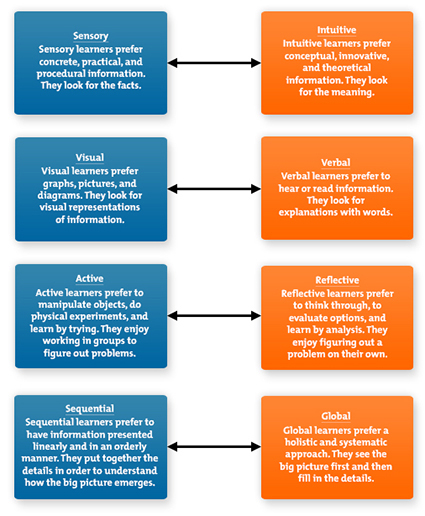
Whenever you are training others, you have information and ideas that you want to share in a way that is meaningful to your audience. Everyone has different learning preferences, so you want your materials to cover a variety of styles to help them to learn quickly and thoroughly. Be aware that your own learning preferences will influence your training techniques, and may shade your information, making it difficult for someone with a vastly different preference to “catch on.” Try to cover all bases by including materials for learners who are:
·         Sensory – Intuitive:  Provide both hard facts and general concepts. Give the learner the philosophy and theory behind the activity (“why are we doing this?” and what are the “rules” we are being held to?) but also give them enough details about the task for the learner to problem-solve and make decisions on their own as they work through it.
·         Active – Reflective:  Allow the learner to complete the task, but also allow time to evaluate and analyze the activity. One rule of thumb is to go over the material three different times: first, complete the task while the learner observes and takes notes; second, the learner completes the task while you provide direction (giving the learner time to add / modify their notes); and finally, the learner completes the task from their notes (while you quietly observe).
·         Sequential – Global:  Provide the big picture, as well as detail in a structured way. I prefer to think of training as taking the audience from the big picture down to the nitty-gritty details. You might open with a quick discussion about why and for whom this activity is being done. Then launch into frequency and quality expectations, and conclude with step-by-step instructions for completion.

Finally, be prepared for a period of time (usually starting 60 – 90 days after training) where the new employee will struggle to complete tasks they were trained on, and may have been successfully completing for a few weeks! This period is normal, have the employee go back to their training materials, slow down their execution, and “re-learn” the activities. This is just the process of the brain moving the material from our conscious memory to our automatic memory.

Job Training

Try to approach your employee training from a broad spectrum of learning opportunities. Each of these methods will give your employees an opportunity to explore, engage with, and solidify their job duties.
1.        Self-Directed Learning
2.        Other-Directed Learning
3.        Informal Training
4.        Formal Training
5.        Coaching

Index of Learning Styles, mindtools.com


Managing Yourself

Managing yourself is about managing personal feelings, personal attitudes, personality preferences and personal behaviors to bring out the best in yourself and others. A quarterback on any given play may have personal feelings about their receiver, but he still must throw to that person to win the play.

First, you must set high standards for yourself and those around you; and you must hold people accountable. Second, you must develop your emotional intelligence skills. Emotional intelligence is the ability to recognize your own emotions, understand how they affect you, and manage your responses with tact. It also involves your perception of others, allowing you to manage relationships more effectively.

To do the best job of managing yourself and role-modeling for others, you need to be:
• Competent in your job
• Committed to the organization and its people
• Trustworthy, reliable and honest
• Fair
• Respectful to everyone, every time
• Aware of and avoid under- or over-managing
• In control of your behavior and not let personal feelings dominate your actions
• Confident that others will be responsible and intelligent

Managers that are truly effective recognize that individuals and work teams need to be experts in their jobs and that people are our best resource. Managers who lead engaged employees:
• Understand themselves and others
• Learn personality preferences or styles and use the knowledge wisely
• Manage their own behavior
• Recognize that effective leadership requires behaviors that they may find uncomfortable or difficult
• Remember that leadership is about getting others to do the right things in the right ways

Some things to keep in mind:
1. Monitor your work hours
2. Recognize your own signs of stress
3. Get a mentor or coach
4. Learn to delegate
5. Communicate as much as you can
6. Recognize what’s important from what’s urgent – fix the system, not the problem
7. Recognize accomplishments

How to Delegate Meaningful Work

          The hallmark of good supervision is effective delegation.  Delegation is when supervisors give responsibility and authority to subordinates to complete a task, and let the subordinates figure out how the task can be accomplished.  Effective delegation develops people who are ultimately more fulfilled and productive.  Supervisors become more fulfilled and productive themselves as they learn to count on their staff and are freed up to attend to more strategic issues.

Delegation is often very difficult for new supervisors.  Many supervisors want to remain comfortable, making the same decisions they have always made.  They believe they can do a better job themselves.  They don’t want to risk losing any of their power and stature.  Often, they don’t want to risk giving authority to subordinates in case they fail and impair the organization. Finally, delegating takes time and effort to prepare the information and communicate desired results. It may seem easier to do it yourself, rather than take the time to show someone else how.

Delegating the tasks you have mastered will free you up for more challenging work that develops you; and will build your employees’ skills and abilities. You want to foster employee involvement and employee empowerment to enable your team members to deliver their best effort at work.  These tips for successful delegation will help you help your employees succeed when they are most empowered. 

Employee - select an appropriate employee, one with the right level of experience and time.  If you select an employee who will need training, be sure to account for this in your presentation of the project or task.

Big Picture - whenever possible, give the person a whole task to do.  (If you can’t give the employee a whole task, make sure they understand the overall purpose of the project or task.  If possible, connect them to the group that is managing or planning the work.  Staff members contribute most effectively when they are aware of the big picture.)

Establish Expectations - make sure the employee understands exactly what you want them to do and when you want it completed.  Ask questions, watch the work performed, provide examples, or have the employee give you feedback to make sure your instructions were understood. Include in your expectations a list of outcomes or ways the task must be completed grouped by importance: “must haves,” “nice-to-haves,” and “non-directed.”

Authority - give authority to match the level of responsibility.  Be sure to let the employee know when they can make decisions and when they need to consult you.  Below is a list of delegation levels with examples of when to use each one:
·         Tell – the delegate has low ability; the project must be done a particular way; surprises are not acceptable
·         Sell – the delegate has moderate ability; the project must be done a specific way
·         Test – you have ideas but are open to other ideas and insights
·         Consult – the delegate has moderately high ability; others might have innovative ideas or know more than you do
·         Delegate – the delegate has high ability; you can define the vision and don’t need to know the how

Checkpoints – identify the key points of the project or dates when you want feedback about progress.  This is the critical path that provides you with the feedback you need without causing you to micromanage your direct report or team.  You need assurance that the delegated task or project is on track.  You also need the opportunity to influence the project’s direction and the team or individual’s decisions.

Closure – after the task or project is completed, meet with the employee to review how the delegation went. 
·         Did you select the right employee?
·         Did the employee have enough authority to keep the project moving? 
·         Were the timelines realistic? 
·         Did the employee have access to tools and training necessary to complete the project? 
·         Were the instructions clear and concise?


When you receive the delegated work back, give yourself enough time to review it thoroughly. If you accept unsatisfactory work, the employee does not learn how to do the job properly. Go over your review with the employee step-by-step, so that they can learn your review process and understand more about the desired results. Of course, if their work is good, make sure to reward the results using your highly-honed feedback skills.

    Problem Solving

    Much of what supervisors do is solve problems and make decisions.  New supervisors, in particular, often solve problems and make decisions by reacting to them.  They are “under the gun”, stressed and very short for time.  Consequently, when they encounter a new problem or decision they must make, they react with a solution that seemed to work before.  It’s easy with this approach to get stuck in a circle of solving the same problem over and over again. 

    To prevent this as a new supervisor, get used to an organized approach to problem solving.  Much of your problem-solving confidence will come from having a tried-and-true process to solve problems quickly and effectively. Below are six steps to frame your problem-solving process.

    1.        Define the Problem – identify the problem as specifically as possible.  Evaluate the present state and determine how it differs from the goal state.  Writing it down can be very helpful in clarifying and organizing your thoughts. Taking the time during this step will ensure that a) there is a problem; and b) that your solution actually addresses the real problem. So often, when we hear about a potential problem we race to act. A lot of time and resources can be saved by spending time defining the root cause.  
    2.        Analyze the Problem – learn as much as you can about it.  It may be necessary to look beyond the obvious, surface situation, stretch your imagination and reach for more creative options.
    a.        Interview others who are involved
    b.        Be flexible in your analysis
    c.        Consider various strands of impact
    d.        Brainstorm about all possibilities and implications
    e.        Research problems for which you lack complete information
    f.         Seek help – consult your coach or mentor, or discuss with your department head
    3.        Formulate Possible Solutions – identify a wide range of possible solutions.
    a.        Be creative
    b.        Consider similar problems and how you have solved them
    c.        Use advice from more experienced supervisors
    d.        Check for existing company resources regarding the same or similar problems
    4.        Evaluate Possible Solutions – weigh the advantages and disadvantages of each solution.  You may use a classic “Pros & Cons” T-diagram to organize your thoughts.
    a.        Think through each solution and consider how, when, and where you could accomplish each. 
    b.        Consider both immediate and long-term results. 
    c.        Mapping your solutions can be helpful at this stage.
    5.        Select One Solution – consider compatibility with your priorities, amount of risk, and practicality.
    6.        Monitor the Solution – revisit the solution to evaluate the effectiveness.  You may need to tweak the results to get to the goal state.

    Keys to Problem Solving

    Think aloud – problem solving is a cognitive, mental process.  Thinking aloud or talking yourself through the steps of problem solving is useful.  Hearing yourself think can facilitate the process.  If you are not in a place where you can think aloud, use a word processor on your computer.

    Allow time for ideas to “gel” or consolidate.  If time permits, give yourself time for solutions to develop.  Distance from a problem can allow you to clear your mind and get a new perspective.

    Talk about the problem – describing the problem to someone else and talking about it can often make a problem become clearer and more defined so that a new solution will surface.


    Think maybe your problem-solving skills are already up to the challenge? Take this quiz and find out! How Good Is YourProblem Solving?

    Roles of Supervisors

    At times, we've all felt like Dorothy did in the Wizard of Oz – in a strange place, surrounded by people from a different culture, wearing shoes that we would never wear at home. Take heart: Dorothy soon found her way home, making friends and learning something about herself along the way.

    Dorothy’s journey through Oz was guided by a well-defined path and kind people playing critical roles along the way. Some of them merely pointed the way (think of the Lollipop Gang) and some were vested in her success (the Lion, Scarecrow, and Tin Man). Without each of these types stepping in and playing out their roles during Dorothy’s struggle, she may never have made it home to Kansas.

    Today's supervisors are expected to provide the same kind of guidance and support for their employees. At different times during their career, the employee needs different types of support. While we’ve all had days where we just wish we were home, as supervisors, it’s up to us to give our employees the right kind of guidance at the right time. Below are four roles that supervisors can play – not just for their employees, but for others too.

    Coach

    A good supervisor places a high priority on coaching employees. Good coaching involves working with employees to establish suitable goals, action plans and timelines. The supervisor delegates and also provides ongoing guidance and support to the employee as they complete their action plans. Rarely can job goals be established without considering other aspects of an employee’s life, e.g., time available for training, career preferences, personal strengths and weaknesses, etc.

    Mentor

    Usually the supervisor understands the organization and the employee’s profession better than the employee. Consequently, the supervisor is in a unique position to give ongoing advice to the employee about job and career. The employee can look to the supervisor as a model for direction and development. A good supervisor can be a priceless addition to the career of an employee.

    Advocate for the Company

    The supervisor is often the first person to tell employees about new policies and programs from management. It’s not uncommon for employees to be confused or frustrated by these new actions, and need further clarification and support from supervisors. In the rapidly changing world of today’s organizations, it can be a major challenge to present new programs to employees. The supervisor must be authentic, yet tactful.

    Advocate for the Employee

    The supervisor is often responsible for representing the employee’s requests to management, along with making a case for a deserving reward. If the employee has a rather unique personal situation that warrants special consideration by the rest of management, the supervisor must tactfully explain that situation and how it can be handled. It’s not unusual for employees to sometimes see the supervisor as part of “management” while at other times seeing the supervisor as a friend.


    Next topic: Problem-Solving

    Organizational Culture

              Every business has a culture - whether or not it is intentional.  Savvy companies know their culture, and actively manage it.  Quantifying or identifying a culture can be difficult.  Often, the culture implied in the mission or values statement is not what is perceived by customers and employees.
              Just as there are many, many personality tests and ways to categorize people's response, there are many different culture types.  A lot of research exists in an attempt to simplify the mechanism of culture.  One elegant tool is the Competing Values Framework.
              The Framework provides a structure to identify the various harmonies and tensions within a company.  It also provides terminology and values to develop the overall company strategy and to identify leadership types.  While there are four culture types identified, they are actually a result of two different continuum.  The first is a line from flexibility / adaptability to stability / control.  The second is a line from efficient internal processes to competitive external positioning.
              These concepts should sound familiar:  internal vs. external and stable vs. flexible are concepts that frequently come up in personality and behavior tests.  What's intriguing is not the framework, or the specifics of each culture, it is the application of the framework.  In a business, there are layers of functions, and not each one has the same culture or behavior.  These layers are the company as a whole, individual departments (or teams), functions within the departments, and leaders.
              Take a consulting business, for example.  In general, the consulting business should be externally focused.  The business can range somewhere along the line from stable to flexible, depending on their business platform.  Within the consulting business is the Accounting Department, which should be internally focused and stable, with specific procedures followed.  The CFO should balance between and external focus and a flexible approach to solutions, and the Accounting Clerk should be pretty internal with a stable approach.  The Sales Department may have the opposite culture, one that is highly flexible with an external focus.  Innately, the Accounting Clerk's role is going to have conflict with the Sales Representative's role.
              The business imperatives for each layer may shift to support the appropriate framework identified.  Each one will support the layer above, in such a way as to provide a structure for the company to operate and refer to during decision-making events.  The Framework can also provide terminology to use when defining culture, and broaden the understanding of multiple cultures within a company.  Finally, the Framework is a way for companies to understand and manage the innate friction that arises between cultures.

    Are You Ready to Try To Take Over the World?

              Before you hire a business coach, you've got to be able to answer one question: 
    Are you ready to make a change?
              If you want to leave a legacy, you have to be prepared to answer the tough questions.  Maybe you already own a business, maybe you are just getting one started, or maybe you have an idea for a business cradled in your thoughts.  The first thing I ask when I look at a business plan, or hear an elevator speech, or talk to an owner about their business is:  
    "What are you going to do that's different from what you are doing right now?"
              You have a choice, my friend.   You can continue to run your business the same way, with the same tools, and the same people.  Do not make the mistake of expecting different results.  This can be a very comfortable business, with adequate returns and satisfaction with a job well done at the end of each day.  You may even excel at Steady Eddy, and win all sorts of Steady Eddy awards (Best Place to Work, e.g.).    
              Or, you can brace yourself for opportunity, and follow in the footsteps of the Brain, from the cartoon series Pinky and the Brain.  Given the opportunity, the Brain will take a chance, risk everything, and go for broke.  The Brain's entire business model is simple:  Try To Take Over The World.
              If finding yourself in the same place, doing the same thing year after year is not what you want, then be prepared to get hurt, be prepared to be ridiculed, be prepared to give it everything you've got and then, you guessed it, Fail.  
              If you truly want to Try To Take Over The World, you will have to change what you are doing.  You may have to change everything you are doing.  You may have to fire your best employee.  You may have to fire yourself.  You might fire your best employee, then yourself, then discover that the two of you were the only ones keeping your business afloat.  You may have to discontinue production of your favorite, best-selling product.  
              Are you ready to do that?  You might not just lose money, you might run your business right into the ground.  But you will have learned some things.  You will know what not to do next time.  Because you have to want this bad enough to give this answer after failure:  

              The first step is to find someone who is business-savvy, and willing to take the gloves off in evaluating your business.  Face it, the business world is brutal, and mean, and it doesn't care if you tried your best.  Excuses don't feed to the bottom line, results do.  When you find that person, let them in to your business, show them everything, then have them write a Management Letter.  I'm not talking about the letter the auditors give you once a year that kindly mentions "deficiencies" and suggests areas for improvement.  I'm talking about an in-your-face, brutally honest evaluation of your business strengths and weaknesses.
              After you've read the letter, pick yourself up, dust yourself off, wipe the blood off your face; and ask yourself again, are you ready to make a change?  What is your capacity for change?  Are you prepared to get beat up, knocked down, and laughed at?  Are you prepared to sacrifice the very things that you think make you successful (such as your position as leader of your business)?  If your answer is yes - emphatically "yes!"  Then you are ready to transform your business into something more than a living.

    "The Brain: Pinky, are you pondering what I'm pondering? 
    Pinky: I think so, Brain, but this time, you put the trousers on the chimp."

    UnCoachable in 4 Easy Steps

              You're ready to invite someone in to help you find your way to your dream success.  Whether you are just starting your business, or you've been at it for years, you have finally reached the point where you are ready to pay someone to guide you through the next phase.
              There are lots of business coaches out there, with expertise in a variety of backgrounds and many different approaches.  There's sure to be one that fits you.  If you love seeing your coach and you want your coaching to drag on, keep reading.  If you have no tolerance for change, but you heard that having a coach makes great conversation at parties, keep reading.  If you stubbornly insist on hiring a coach, but not to improve your business, here are a few things to do:
    1. Argue.  When your coach offers direction, argue.  Bring up articles you've read, point out all of the ways that you cannot take the action suggested, and tell the coach how hard it is to follow through.  After all, this is your business, you know what you are doing, and who are they, anyways?  
    2. Don't do it.  You can accomplish this many ways.  You can discuss the direction at length, you can simply ignore it, or you can even nod vigorously and do nothing.  Whatever you choose, do not move in the direction the coach has suggested.  Everyone knows that change is dangerous, you're just preserving your business.
    3. Redirect.  Coaches love it when you share what you learned from someone else, especially if it is out of context and completely contradicts what you've learned from your current coach.  It is your responsibility to be a well-informed participant, and to look at all sides.  Magazine articles and blogs are an excellent, in-depth source of knowledge.  You can use this information to coach your coach (they really love that).  Taking action on this new learning is the way to go, the more it differs from the coaching you've received, the better.
    4. Cry.  If you have a coach who actually cares about your success, there will be times when the coach will put a lot of pressure on you.  The coach may launch into locker room language and say things like, "Do you want to be the best?"  The coach may refer to this as "tough love."  Do not be fooled, this is badgering, plain and simple.  That approach to motivation and team spirit only works in commercials.  When the coach gets in your face, break down in tears.  If you have tried the other steps, this should completely derail the coaching program.
    One final thing to note:  to keep your coach invested in you, you will have to contact them after completing one of these steps.  Wait until the action is irrevocable, then pepper your conversation with apologies and justification.     

    Advisers & Mentors & Coaches (Oh My!)

              Dorothy's journey through Oz was guided by a well-defined path and several types of people.  Alongside the villainous witches, there were friendly advisers and imperfect coaches.  Without each of these types stepping in and playing out their roles during Dorothy's struggle, she may never have made it home to Kansas.  What is the difference between an adviser, a mentor, and a coach; and why do we need all three?
              Advisers are people along the journey who have in-depth knowledge about our conflict at hand.  An adviser would look at our situation, listen to our goals, and offer a solution.  In Dorothy's case, her first encounter was with a group of advisers - the Lollipop Gang.  Their advice was clear and easy to perform, "Follow the Yellow Brick Road."  The Gang did not then join Dorothy on her mission, or check back in with her to see how she was doing.  The Gang was not invested in Dorothy's success.  
              A mentor is someone who can offer guidance, who has connections to smooth the way, and who has already traveled the path.  Dorothy's mentor was the Good Witch, Glinda.  Glinda popped in to check on Dorothy's progress, introduced Dorothy to the right people, offered insight into Dorothy's path and conflicts, and generally wanted Dorothy to succeed.
              Dorothy had three coaches on her journey home, the Lion, the Scarecrow, and the Tin Man.  These people traveled alongside Dorothy, experiencing her setbacks and successes.  All three were fully invested in her journey.  A coach knows the individual, primarily in the setting of the challenge, but also to some degree personally.  The coach's role is to help Dorothy along the path to her goal, through training, encouragement, cajoling, pushing, and sometimes tough love.  A good coach is not a quitter, and the joy of success is shared.

              In Dorothy's story, the appropriate person seemed to show up at the right time.  In real life, how do you know when to invoke which person?
    • Adviser:  when you have a technical question, or you want to know the best course of action for a specific circumstance.  Contact your lawyer and your CPA when you are wondering what type of business entity you want to use.
    • Mentor:  when you want to know how to get further down the path, or to make connections with others.  Take your mentor out to lunch at least once a month to check in on things like getting more education, or networking with others in your business, or how to handle a tough employee.
    • Coach:  when you want someone to hold you accountable to your dream, or when you want a collaborator on your goals.  Contact your coach daily during times of growth and change, even just to check in on progress.  Once a new plan is under way, fewer sessions will help you to maintain perspective, stay focused, and celebrate success.
    Do you know of someone who can fill each of these roles for you?  How do you fill these roles for others?

    4 Steps to Hiring New Employees


              Guest post from Kelly Stanton (bio is at the end):
    Being a hiring manager comes with great responsibility. You won’t hear much about it when you make good hires, people just enjoy having another good team member. But boy howdy will you hear about it  if you make a bad hire! Generally you won’t be alone in those decisions, even at my 18 person company, at least 3 of the management team interviews a candidate, but you’re still somewhat responsible for bringing in good quality candidates. 
              I've been involved in the hiring process for several organizations through the course of my career, and am currently heavily responsible for bringing in candidates at my small consulting firm. Here are some tips from my trial by fire experience.  One would think in this economy with millions of unemployed out there, hiring would be easy. Boy has that not been the case!

      1)  Have clearly defined job descriptions and skill sets required. Prioritize those skill sets!

    I recently had the experience of trying to hire another field service technician for my
    organization. I pulled an old job description and sent it to my colleague, to whom this position reports. He replied that it looked fine, so I posted it. I began filtering resumes with experience that matched the technical details of the position, and had what I felt were some very good candidates. 
              He would phone screen, and none of them were passing. I finally pushed him one day after about a month of this on why none of these seemingly qualified people were meeting his needs. He replied “I need someone who has actually done field service work, not just done calibration for one organization as a direct employee. They don’t have the customer
    service experience to keep our customers happy.” Ohhh…interesting. That was listed on the
    job description down near the bottom in a “nice to have” sort of way. It wasn’t an actual
    requirement, nor was it communicated that it was actually more important than technical
    experience.

      2) Be willing to train some, or be willing to wait a long time on the perfect candidate.

    It happens. Occasionally the perfect fit to your team falls into your lap, or someone you trust knows someone who might be open to considering your position. It happens. But let’s face reality, most of the time, you’re going to have to pick and choose what is most critical about the position and look for just those traits, knowing that you’ll have to train the rest. (see above about prioritize!). 
              Unless you’re willing to up the game by increasing salary, paying a recruiter tens of thousands, or waiting several long months with an open position, the perfect candidate who has every skill you’re looking for and is the perfect fit to your team isn't going to just fall into your lap. If you’re a small organization, the waiting game is painful! You've decided you need the help, and in a small company that usually comes well after you’re overwhelmed with work and are ready to staff up a bit. If you’re in a large organization, you have to weigh the risks of burning out your very good team members left behind by the vacancy as they pick up the slack. Either of these scenarios is tough on existing team retention.

      3) Realize that hiring is going to take a good chunk of your time.

    There are literally millions of unemployed people out there. There are also thousands of those who are currently employed and perhaps unhappy where they are and want to make a change. Be prepared to get bombarded with emails, especially if you post on sites like CraigsList. Set up a generic email address like jobs@yourcompany.com to catch all the fray. Set aside time each day to filter applicants, and keep track of the ones you’d like to contact. Come up with a system that works for you to filter those candidates. 
              In my world (FDA and ISO regulated industries), attention to detail is critical. So one of my very first checks is just that, are there type-o’s and obvious grammatical errors in their cover letter or resume? Written communication is still very important even in this electronic age. Can they write a cover letter/email and not sound like a 3rd grader? Harsh? Perhaps. But remember, we are a consulting firm. We can’t have technicians dealing with customers and sounding like they barely made it through high school English. I’m amazed at how often someone tells me in their description of themselves that they have great attention to detail, and yet I find several misspellings on their resume! 
    "Can they write a cover letter/email and not sound like a 3rd grader?  Harsh?  Perhaps."
              My second filter criteria is to scan the cover letter and resume for keywords/phrases that tell me they actually read my posted job description. I will even consider a candidate who comes right out and says something like “while I do not have specific experience with a Siebel database, I am familiar with other databases such as…” This tells me they understand I need someone who can find their way around a database, and that they are willing to learn.
              My third filter can be in the initial letter from them or the phone screen: “Have you visited our website?” This speaks volumes to whether they are just blasting their resume out there trying to get lucky, or are genuinely interested in joining your organization. This may not be so important to an organization like McDonald's, but in our industry it’s pretty important. Motivated individuals will take the time to understand what you do, and will have some intelligent questions prepared to ask you during the interview process.

      4) Finally you get to the face to face interview.

    If you’ve followed the tips up until now, face to face should be pretty easy. You already know from this person’s resume and preliminary interactions they are qualified for the job. The face to face interview should be more about determining how this person will fit the team.
              The other big thing I look for in an interview is actual experience – tell me about a time when you were at ABC company and XYZ scenario happened. How did you handle it? I find these interactions tell the rest of the story. Did they actually do the work on their resume? Or are they just padding with catch phrases that talk the talk because they read a book, but don’t necessarily translate into real experience? Do they have problem solving skills? Do they take initiative? All these traits will come out in the stories they tell. You’ll also get a good idea about personality and professionalism. Are they bitter and bad mouthing their last boss? Are they a constant victim, or are they positive and view challenges as learning opportunities?

    All in all, hiring is one of the most difficult, yet most critical activities that go on in a business.  A new hire can make or break a team, and it’s up to you as the hiring manager to be  organized in your approach and make the best decisions you can for your organization. No pressure of course.


    About the writer:  Kelly (Brown) Stanton is the Director of Validation Services at Anacor Compliance, a Pharmaceuticals company in the Greater Denver Area.  She provides validation solutions to customers across the US and Canada in the areas of Equipment, Facility, Laboratory, and Analytical Instrumentation.

    How to Host a Successful Meeting

              Have you ever attended or hosted a meeting, only to be disgusted with your fellow attendees' behavior or the complete waste of time?  Wait!  Before you schedule your next meeting as a host or attendee against your better judgement, consider the following.
              Meetings should only be held in two situations:  collaboration or conversation.  Any other circumstances can be taken care of with a memo or a short power point.  If you must hold a meeting, follow these four steps and attendance and attitude will improve:
    1. Send an agenda and your meeting materials the day before.  You may even send a task or reminder set the day before so that people arrive to the meeting informed and ready to go.
    2. Be on time and stick to the meeting time frame.  If the discussion looks like it will go long, reschedule that item for another time.  This is being respectful of other peoples' time, which will be much appreciated.
    3. Invite the right people.  Check your attendee list, are you missing any key decision makers?  Do you have any extra attendees who don't need to participate in the discussion, only be informed of the results?
    4. Send a follow-up with a summary of decisions and assignments that came from the meeting.
    If you are not the meeting coordinator, but you often find yourself attending useless meetings, try these steps to manage your meeting holder:
    • Start meetings on time.  If the meeting holder is late, wait 10 minutes, then send a polite request to reschedule.
    • Request an agenda and meeting materials the day before the meeting.  At first, you may not get anything back.  Stick with it, if the host knows that you are going to request information beforehand, eventually they will catch on and send it with the invite.
    • Keep the meeting time limited.  If a particular topic goes long, suggest moving it to another time.  If the meetings you attend often extend past their time limit, politely excuse yourself from the meeting and offer to contact someone to get the information you will miss.  Sometimes just making this gesture will wrap up a meeting that's dragging.
    • Send a follow-up email outlining the decisions and action steps that you will be taking as a result of the meeting.
    There are just some people out there who are habitually bad meeting participants.  The best you can do is follow the above steps and keep your cool.

    A free resource to help plan, organize, and collaborate your meetings is MeetingKing.  It's an online tool to create agendas, store and share documents, track tasks, and keep a record of past meetings.  

    Watch Your Language!

              So often what we say carries emotional meaning.  Our inner dialog is running all day long, providing commentary on our actions, activities, feelings, and interactions with others.  On a good day, what we say might boost us up.  More often, we fall in the habit of destructive self-talk.  We berate ourselves for making a mistake, we sabotage our efforts to improve, and we overwhelm ourselves with vague obligations.
              What we say to ourselves should be uplifting, encouraging, and, well, nice.  In the spirit of changing a habit, below is a list of words to listen for.  Once you are aware of the troublesome words, replace them with another one (suggestions are to the right).

    • Should  - this is a vague guilt-trap, instead say you are going to (and list a specific date), or release yourself and say that you don't have to.  
      • Example:  I will eat better starting today.
    • Race - this word and many others (rush, scramble, e.g.) imply that you are performing under pressure, instead use less aggravating words such as "completed" or "did."
      • Example:  We completed the project under deadline.
    • Need - this word is life or death, without this thing or action, you will die.  Replace this word with "would like" and it won't feel so urgent.
      • Example:  I am following my budget more carefully.
    • Can't - this word defeats you before you've even started.  Say that you are going to do this, or say that you have chosen not to do it.
      • Example:  I won't be completing that project because another opportunity has come up.
    • Try - using this verb means that you made an unsuccessful effort.  If you haven't even started (you are going to try) then you have already determined that you will not succeed.  Eliminate this from your vocabulary and skip right to the next word to be more decisive and positive.
      • Example:  I will be at the Monday status meeting on time.
              As you read through the list, think about how these words make you feel.  Then read through the alternate list and think about how those words make you feel.  To finish the habit loop, tell your coworkers and your family which words you are going to eliminate, then check in to see how you are doing.

    Did I miss any words?  Which words are triggers for you?